Where Precision Stainless TIG Welding Is Used
Precision stainless work shows up wherever a part has to stay clean, hold size, and resist corrosion for years. The same welding controls apply across these markets, but each one adds its own inspection and paperwork rules.
Medical and Lab Equipment
Thin-wall housings, carts, frames, and fluid parts where welds must be smooth and easy to clean. See medical device manufacturing.
Semiconductor and Analytical Tools
Brackets, chambers, and gas system parts where weld color and cleanliness matter. See semiconductor cleanroom welding.
Aerospace Ducting and Brackets
Stainless ducts, clamps, and brackets built to AWS D17.1. See aerospace TIG welding.
Food and Process Equipment
Machine parts, guards, and fittings that face washdown and cleaning chemicals. See sanitary tube welding.
Stainless Steel TIG Welding by Grade
The base metal decides the filler, the shielding gas, and the heat limits. We confirm the grade from your mill test report before we strike an arc.
ER308L and ER316L Filler Rod Specs
ER308L is the standard filler for 304 and 304L. ER316L adds about 2 to 3 percent molybdenum for better pitting resistance in chloride service, and it is the match for 316 and 316L. Compare them in ER308L vs. ER316L filler rod.
321 and 347 Stabilized Grades
321 stainless uses titanium to tie up carbon at high temperature. It is usually welded with ER347 filler, because titanium does not transfer well across the arc.
Duplex 2205
Duplex needs a balance of ferrite and austenite in the weld. We use ER2209 filler, control heat input, and can check ferrite content when your spec calls for it.
Stainless to Carbon Steel
Dissimilar joints use ER309L to handle dilution from the carbon steel side. See how to TIG weld 304 stainless to carbon steel.
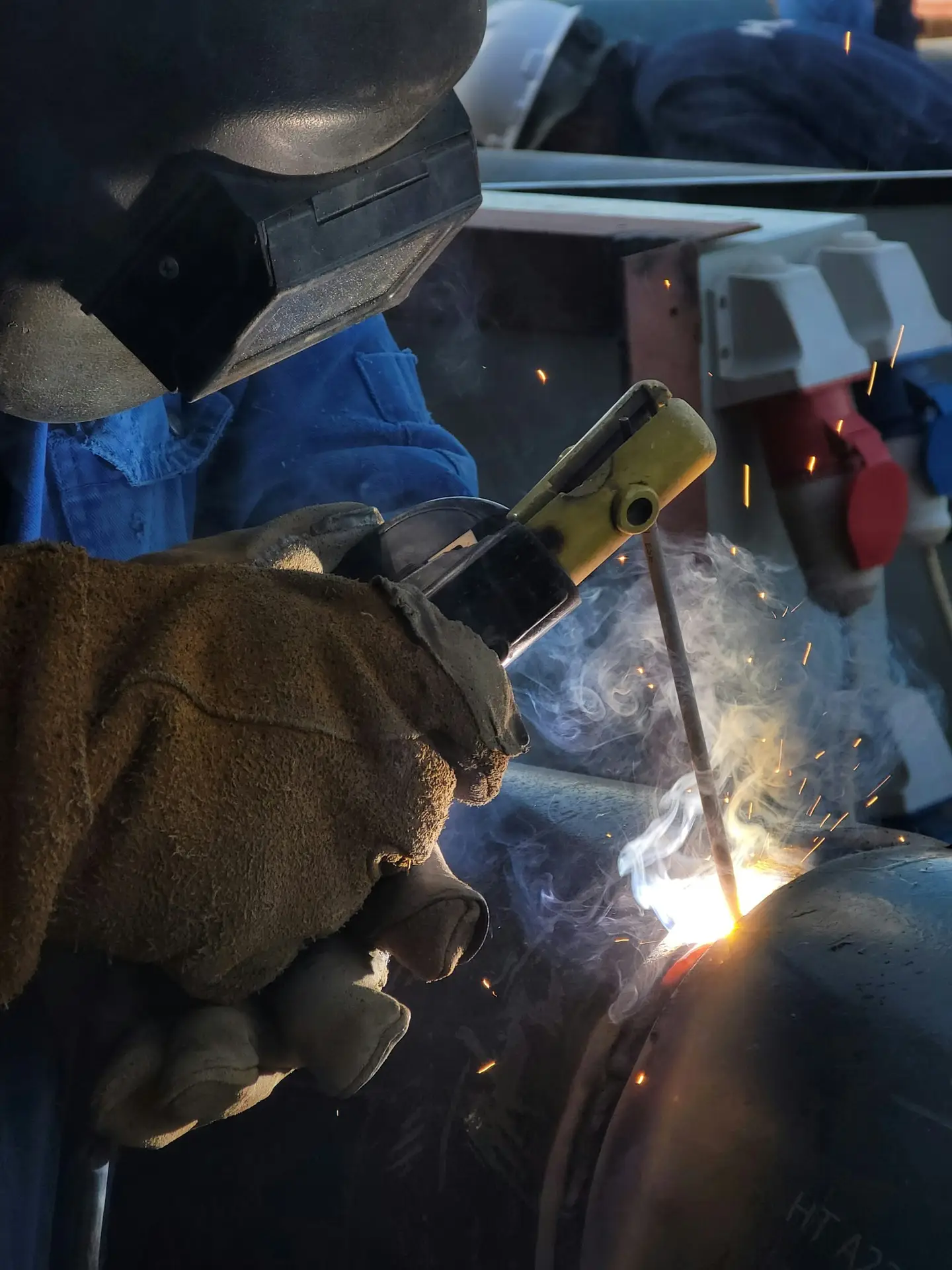 A TIG torch and hand-fed filler rod give the welder close control of heat on thin stainless.
Heat Input Control to Prevent Warpage and Sensitization
Stainless holds heat near the weld. It also expands roughly 40 to 50 percent more than carbon steel when hot. Too much heat pulls parts out of flat and can drop chromium carbides at the grain boundaries.
We track heat input with a simple formula: HI = volts × amps × 60 ÷ travel speed (in/min). That number goes on the procedure, so every welder runs the joint the same way.
Pulse TIG and Low Amperage
Pulse settings cool the puddle between peaks. This keeps heat low on thin wall. Learn more in preventing warpage in thin-gauge stainless.
Fixtures and Chill Blocks
Copper or aluminum chill bars pull heat out of the joint. Rigid fixtures hold size while the weld cools.
Interpass Temperature Limits
We hold interpass temperature at or below the procedure limit on multi-pass welds.
Avoiding the Sensitization Range
Austenitic stainless sensitizes when held around 800 to 1600 °F. L grades and fast travel cut that risk. Read carbide precipitation in stainless welds.
Shielding Gas, Purge, and Weld Color
Oxygen is the enemy of a stainless weld. On the torch side we use pure argon or an argon blend. On the back side of tube, pipe, and closed shapes we purge with argon until oxygen is low enough to weld.
Weld color tells you how well that worked. Straw to light blue tint is common on the face. Dark blue, gray, or crusty sugaring on the back side means the purge failed.
- Torch gas: argon, with flow set by cup size
- Gas lens and large cups for better coverage on thin parts
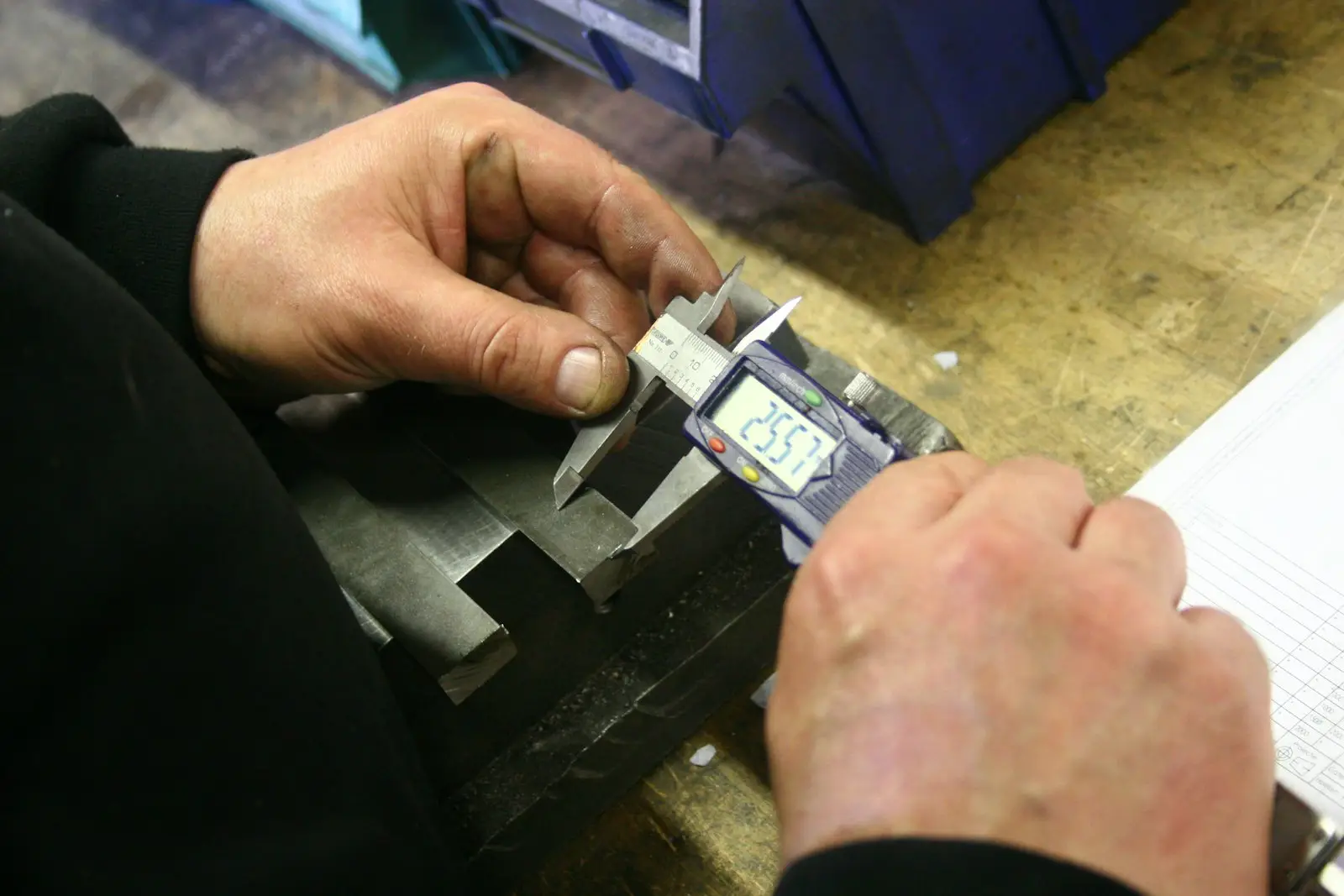 Welded parts are measured against the drawing before they ship.
Inspection and Documentation
You get proof, not just parts. Our standard and optional checks are below. Certifications are listed on the certifications and compliance page.
Visual and Dimensional
Every weld gets a visual check for undercut, porosity, cracks, and color.
Dye Penetrant Testing
Liquid penetrant testing finds surface cracks and pinholes the eye can miss.
Ferrite and Material Checks
Ferrite readings and positive material ID (PMI) are available when your spec asks for them.
Data Package
Typical records include MTRs, the WPS and welder qualification, inspection results, and a certificate of conformance.
Common Stainless Weld Defects and How to Prevent Them
Most stainless weld rejects come from a short list of causes. Each one has a known fix that belongs in the procedure, not in a rework step after the part fails inspection.
Sugaring on the Root
Gray, crusty oxide on the back of the weld. Caused by air reaching the hot root. Prevented with a full argon back-purge and an oxygen check before welding.
Lack of Fusion
The weld sits on the joint instead of melting into it. Caused by poor fit-up, wrong joint prep, or too little heat. Prevented with tight fit-up and a qualified procedure.
Porosity
Gas pockets trapped in the bead. Caused by oil, moisture, dirty filler, drafts, or poor gas coverage. Prevented with clean metal and filler, a gas lens, and shielded work areas.
Hot Cracking
Cracks that form as the bead solidifies. Austenitic fillers with a small amount of delta ferrite resist it, which is one reason the filler choice matters.
Distortion
Parts pulled out of flat or out of square. Prevented with low heat input, balanced weld sequences, chill bars, and rigid fixtures.
Heat Tint Left in Place
Colored oxide next to the weld is lower in chromium and can rust in service. Removed by mechanical cleaning, pickling, or passivation when the spec calls for it.
How to Specify Stainless TIG Welding on Your Drawing
A complete drawing gets you a faster quote and fewer questions. These are the callouts we look for first. If one is missing, we will ask before we price the job.
- Base metal grade and form, such as 316L sheet or 304L tube, with any MTR requirement
- Weld symbols per AWS A2.4, with size, length, and all-around or field-weld flags
- Filler metal, if your spec fixes it, or a note that the supplier selects it
- The governing code or spec, such as AWS D1.6 for structural stainless, AWS D17.1, or your company standard
- Finish and cleaning: heat tint removal, passivation per ASTM A967 or A380, or a surface finish callout
- Inspection and records: visual, penetrant, dimensional report, and certificate of conformance
- Critical dimensions and datums, so the weld sequence can protect them
What Drives the Cost of Precision Stainless Welding
Welding time is only part of the price. Fit-up, purging, inspection, and finishing often cost more than the arc time itself. Knowing the drivers helps you design parts that cost less to build. For the full breakdown, read what drives the cost of outsourced TIG work.
- Total weld length and the number of separate joints
- Fit-up time and whether the part needs a custom fixture
- Back-purge needs on tube, pipe, and closed shapes
- Inspection level and the size of the data package
- Post-weld finishing such as blending, graining, or passivation
- Order quantity, since fixtures and setup spread over more parts on repeat orders
Frequently Asked Questions
What filler rod should be used to TIG weld 316L stainless?
ER316L is the normal choice for 316 and 316L. It contains molybdenum, which keeps pitting resistance close to the base metal. Using ER308L on 316L lowers corrosion resistance at the weld.
How do you keep thin stainless parts from warping?
We keep heat input low with pulse TIG, use chill bars and rigid fixtures, and plan the weld sequence so heat spreads evenly. Skip or stitch welding also helps on long seams. We check flatness against your drawing before the part ships.
Why does my stainless weld look gray or black on the back side?
That is heavy oxidation, often called sugaring. It happens when the back of the weld is not shielded from air. It cuts corrosion resistance and is a reject in most specs. A full argon back-purge prevents it.
Can you remove heat tint after welding?
Yes. Heat tint is a chromium-poor oxide layer that can rust if left in place.
What tolerances can you hold on welded stainless assemblies?
Tighter features are often machined after welding. Tell us your critical dimensions and we will plan the weld sequence around them.
Is TIG or laser welding better for thin stainless parts?
Laser welding puts in less heat and runs fast, which suits high volumes of identical parts with very tight fit-up. TIG is more flexible for low and medium volumes, varied joints, and gaps that need filler. Many precision parts are TIG welded because the joint design changes from job to job.
Do I need to passivate stainless after welding?
Welding and heat tint lower the chromium at the surface near the weld, and shop handling can leave free iron behind. Passivation per ASTM A967 or A380 restores the passive layer. It is required by most sanitary and medical specs and is a good idea for any part in a corrosive service.
What should I send for a stainless welding quote?
Send a PDF drawing and a STEP file if you have one, the grade, the quantity, and any code, finish, or inspection callouts. Use our request a quote form to upload files.