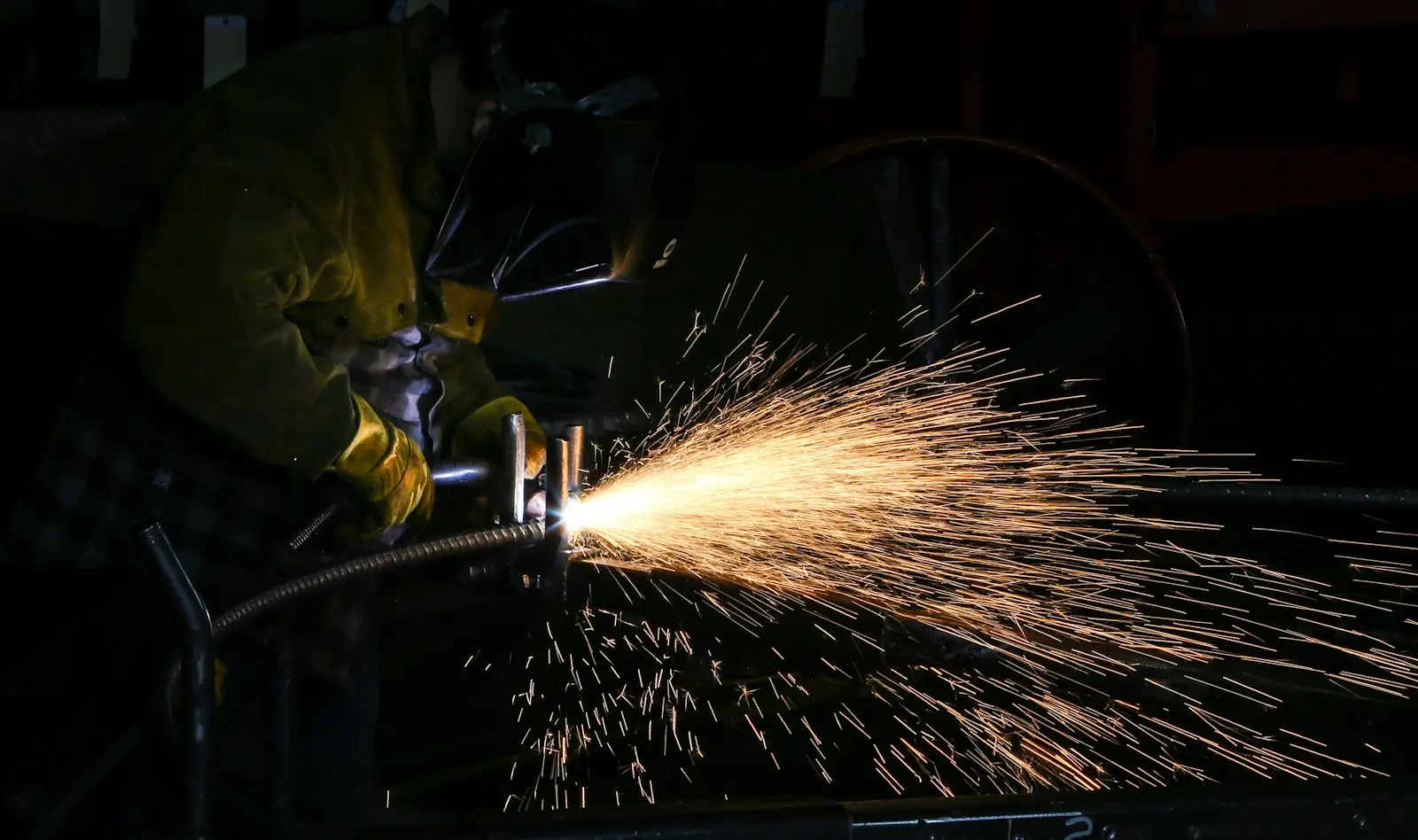
ASME Section IX Welding Qualifications
ASME Section IX does not tell you how to design a vessel. It tells you how to prove a weld procedure and a welder can make a sound joint. The construction code, such as Section VIII or B31.3, then points to Section IX.
Read the full process in ASME Section IX: certifying TIG welds for pressure vessels.
WPS: Welding Procedure Specification
The written recipe for the weld: process, base metal P-number, filler F-number, position, preheat, and heat input range.
PQR: Procedure Qualification Record
The test record that proves the WPS works. A test coupon is welded, then cut for tensile and bend tests.
WPQ: Welder Performance Qualification
Proof that a given welder can make a sound weld with that procedure. Welders must stay in continuity to keep it active.
Process Piping and Pressure Vessel Codes
The code depends on what the pipe or vessel does. We build to the code on your PO and your owner's spec.
ASME B31.3 Process Piping
Refinery, chemical, and plant piping. Sets design, fabrication, and exam rules by fluid service category.
ASME B31.1 Power Piping
Steam and power plant piping.
ASME Section VIII Division 1
Unfired pressure vessels. Code-stamped vessels need a shop with a U stamp.
NBIC Repairs
Repairs and alterations to stamped vessels fall under the National Board Inspection Code and need an R stamp.
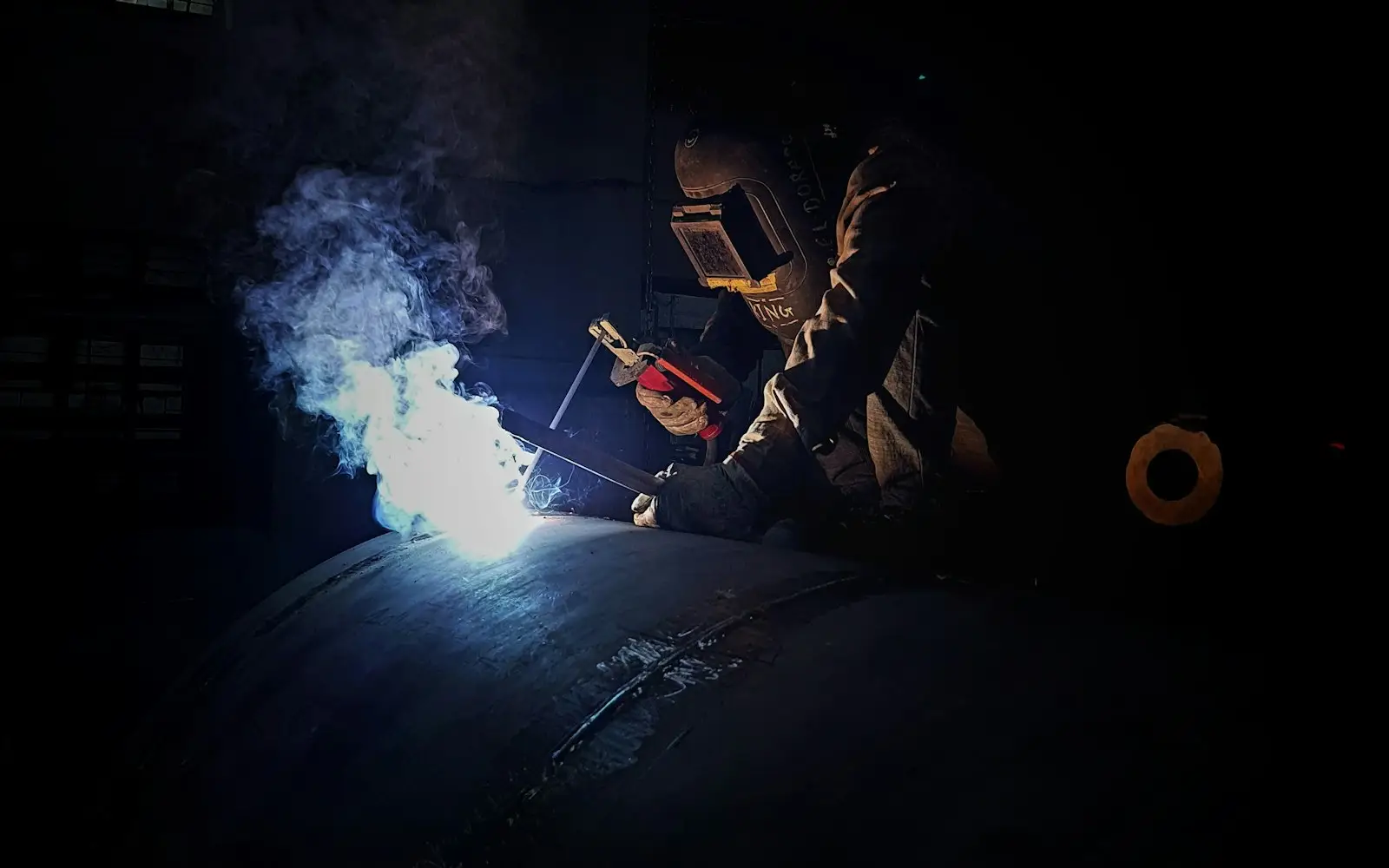 A TIG root pass gives a smooth, full-penetration inside bead on code pipe.
TIG Root Passes on Stainless, Carbon, and Chrome-Moly
A TIG root gives a smooth, full-penetration inside bead. Many shops then fill and cap with TIG or stick, depending on wall thickness and spec.
Carbon Steel (P-No. 1)
TIG root with ER70S-2 or ER70S-6 filler. Sour service lines may also need hardness limits per NACE MR0175/ISO 15156.
Austenitic Stainless (P-No. 8)
TIG with ER308L or ER316L and an argon back-purge to stop root oxidation. Low heat input limits sensitization.
Chrome-Moly Alloy Steels
Alloys such as P11, P22, and P91 need preheat, interpass control, and post-weld heat treatment. Each falls in its own P-number group.
Dissimilar Joints
Stainless to carbon steel joints often use ER309L. See welding 304 stainless to carbon steel.
Testing and Nondestructive Examination
Code welds are examined before they go into service. The code and fluid service set how much of each method is required.
- Visual examination of every weld
- Radiographic testing (RT) per ASME Section V
- Ultrasonic testing (UT), often used in place of RT on thick wall
- Liquid penetrant (PT) and magnetic particle (MT) for surface flaws
- Hydrostatic test
- PMI on alloy materials when the owner spec requires it
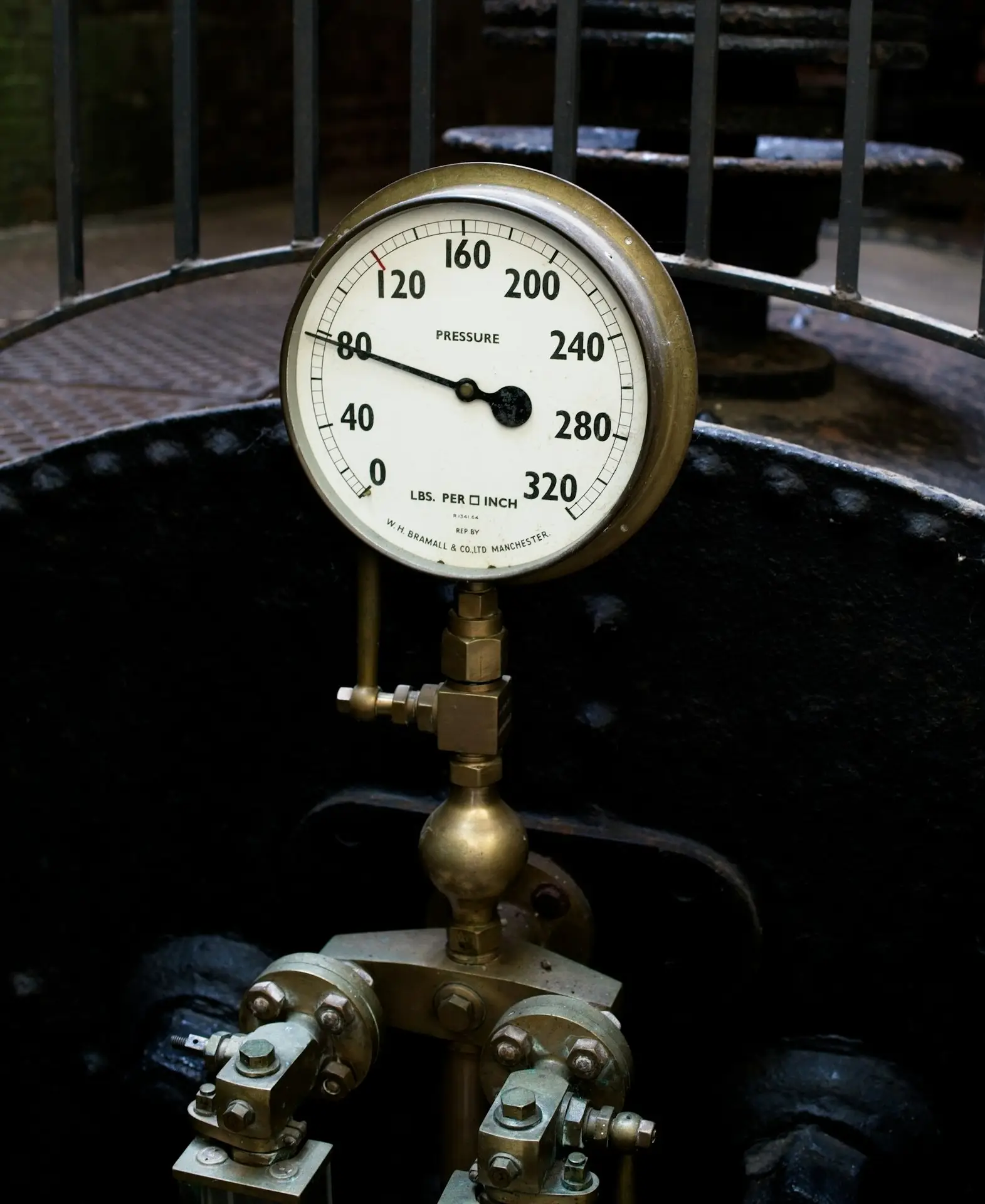 Pressure testing proves a welded system holds before it goes into service.
Why TIG for the Root Pass
The root pass is the first weld in a pipe joint and the one that forms the inside surface. It is also the hardest pass to inspect and repair, so it gets the most careful process.
TIG gives the welder close control of the puddle on an open root. The result is full penetration with a smooth inside bead and few defects. After the root, the joint is often filled and capped with TIG or another process, as the WPS allows. A TIG root with a stick fill and cap is a common combination on carbon steel pipe.
Pipe Spool Fabrication
A pipe spool is a section of piping welded in the shop, then shipped to site for installation. Building spools in a shop moves most of the welding out of the field.
Controlled Conditions
Shop welding avoids wind, rain, and awkward positions, which helps weld quality and purge control.
Better Inspection Access
Spools can be rolled and examined before installation, when repairs are easier.
Less Field Time
Fewer field welds mean shorter shutdowns and less work at the plant.
Isometric Drawings
Spools are built from isometric drawings that show every weld, fitting, and dimension, with weld numbers for the weld map.
How to Specify Code Pipe and Vessel Welds
Code work starts with the right information. These items let us check procedure coverage before we quote.
- The construction code and edition, such as ASME B31.3, B31.1, or Section VIII Division 1
- Fluid service category under B31.3, such as Normal, Category D, Category M, or High Pressure
- Base metals and P-numbers, pipe sizes, and wall thickness
- NDE extent and methods, such as random radiography or 100 percent UT
- Pressure test type and any post-weld heat treatment
- Owner spec requirements such as PMI, hardness testing, or NACE MR0175/ISO 15156
- Records: WPS, PQR, WPQ, weld map, NDE reports, and material certs
What Drives the Cost of Code Welding
Code work is priced by the weld, but the weld is rarely the biggest cost. Exams, heat treatment, and paperwork add up fast.
- Number of joints, pipe size, and wall thickness
- Material, since chrome-moly and alloy pipe need preheat and heat treatment
- NDE extent, from random spot checks to 100 percent examination
- Procedure coverage, if a new WPS must be qualified for the job
- Pressure testing and the size of the turnover package
Frequently Asked Questions
What is the difference between a WPS and a PQR?
The WPS is the instruction sheet welders follow. The PQR is the test record that proves the WPS makes a sound weld. Every code WPS must be backed by at least one PQR.
Why use TIG for the root pass on pipe?
TIG gives a clean, controlled root with full penetration and a smooth inner bead. That matters for flow, cleaning, and passing radiography. The fill and cap can then be done faster with other processes when the WPS allows.
Can TIGTechs code-stamp a pressure vessel?
If we do not hold the stamp for your scope, we can still build parts and spools under your stamp holder's quality program.
What causes code welds to fail radiography?
Common causes are lack of fusion, incomplete penetration, porosity from poor gas coverage, and tungsten inclusions. Clean fit-up, correct purge, and qualified welders prevent most of them.
Do you supply weld maps and NDE reports?
Yes. A typical package includes the weld map, WPS and PQR, welder qualifications, NDE reports, MTRs, and hydro test records.
What does Category D mean under ASME B31.3?
Category D is a fluid service that is nonflammable, nontoxic, and not damaging to human tissue, with design pressure of 150 psig or less and design temperature between minus 20 and 366 °F. It allows reduced examination compared with Normal fluid service. The owner assigns the category.
How much radiography does B31.3 require?
For Normal fluid service, B31.3 requires random examination of at least 5 percent of circumferential butt welds. Category M and High Pressure services require more. Your owner spec may also ask for more than the code minimum.
Can stainless and carbon steel pipe be welded together?
Yes. Dissimilar joints are common and are usually welded with ER309L filler. The joint needs its own qualified procedure, because the base metals fall in different P-number groups.