The cost of outsourced TIG fabrication is driven mostly by skilled labor time, then by testing and compliance, consumables such as argon, and raw material. The lowest quote is not always the lowest total cost, because rework, failed inspections and missing paperwork show up later as delays and scrap.
This guide breaks down each cost driver for finance and supply chain leads, shows an illustrative quote split, and lists the steps buyers can take to lower cost without adding risk.
Why does TIG welding cost more than MIG?
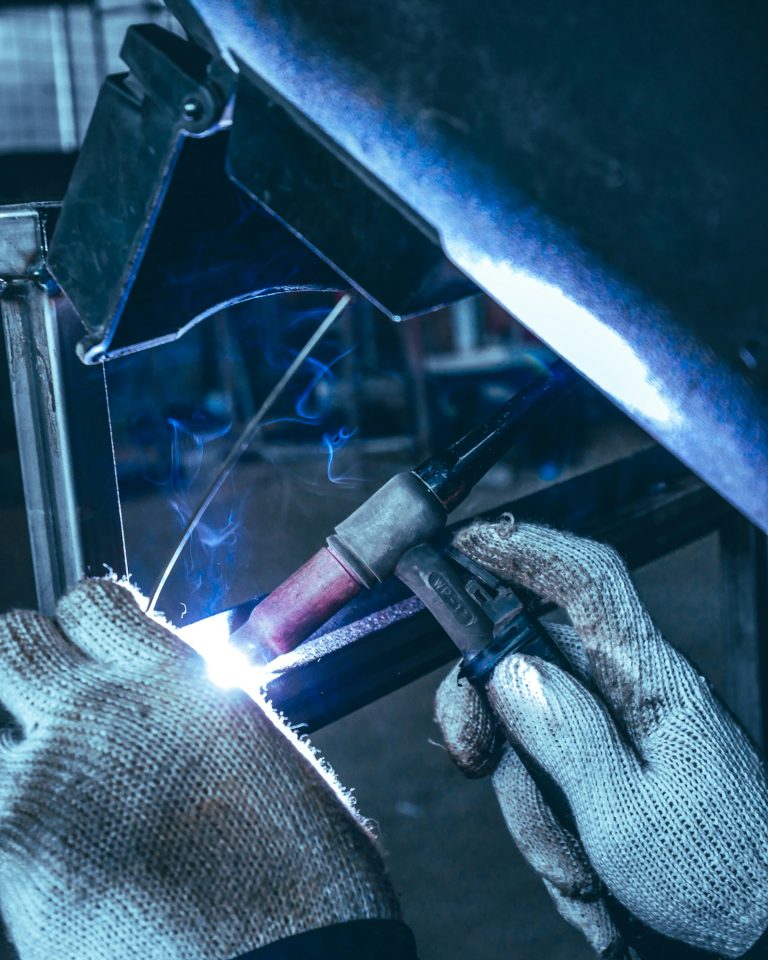
TIG is a slow, hands-on process. The welder holds a short arc with one hand and feeds filler rod with the other. It lays down less weld metal per hour than MIG. Buyers still choose TIG for clean, precise welds on thin stainless, aluminum and titanium, and for welds that must pass close inspection. That precision costs arc time.
Prep adds more hours. Tight fit-up, clean edges and back purging are part of every good TIG weld on stainless. On small precision parts, prep and handling can take as long as the welding itself.
Cost Driver 1: Certified-Operator Labor
Labor is usually the largest line in a TIG quote. You pay for the hours, and you pay for the qualified welder behind them.
- Qualification: Welders test to a code such as ASME Section IX, AWS D1.6 for structural stainless, or AWS D17.1 for aerospace. Each test uses coupon material, shop time and often outside lab fees.
- Continuity: A qualification lapses if the welder does not use the process for a set period. Under ASME Section IX that period is six months. Shops spend staff hours keeping these records current.
- Scarcity: Welders who can pass aerospace, pressure or UHP work are harder to hire and earn more. That premium flows into the shop rate.
- Support labor: Fit-up, fixturing, cleaning, passivation and inspection hours sit on top of arc time.
Setup labor matters most on small orders. Building a fixture and running a first-article check takes about the same time for 5 parts as for 500. Spread over 5 parts, it can drive the unit price.
Cost Driver 2: Argon and Other Consumables
Argon is the main TIG consumable. A torch commonly runs about 15–25 CFH. Back purging tube or pipe adds more, because the whole ID must fill and stay below an oxygen limit before and during the weld.
Simple math shows how it adds up. A cylinder that holds about 300 cu ft, flowing at 20 CFH, lasts about 15 hours. Pre-flow, post-flow and purge time all draw gas, not just arc time. Shops that weld stainless tube also buy purge dams, tape and oxygen analyzer sensors.
Other consumables include tungsten electrodes, gas lenses and cups, abrasives, and pickling or passivation chemicals. Stainless filler rod such as ER308L, ER316L and ER309L costs more than carbon steel wire. Our guide to ER308L vs. ER316L filler rod explains when the 316L premium makes sense.
Cost Driver 3: Testing and NDT
On critical work, inspection can cost as much as the weld. Each method adds labor, equipment or a third-party bill.
| Method | What it finds | What drives its cost |
|---|---|---|
| Visual (VT) | Surface flaws, weld profile, color | Inspector time and certification, such as an AWS CWI |
| Liquid penetrant (PT) | Cracks and pores open to the surface | Chemicals, cleaning, dwell time |
| Radiography (RT) | Internal porosity, lack of fusion | Film or digital setup, radiation safety, often a third party |
| Ultrasonic (UT) | Internal flaws, mostly in thicker sections | Certified technician, calibration blocks |
| Hydrostatic or pneumatic test | Leaks and strength under pressure | Fixturing, test time, records |
| Helium leak test | Very small leaks | Leak detector, setup time |
NDT technicians are usually certified under ASNT SNT-TC-1A or a similar program. The code and the weld class decide how much testing applies. A 100% RT requirement on a pressure part costs far more than a sampling plan. Our guides to ASME Section IX and AWS D17.1 show where those rules come from.
Cost Driver 4: Quality System Overhead (ISO 9001 and AS9100)
A certified quality system is a fixed cost the shop spreads across every job. It covers
- Registrar audits and internal audits each year
- Gauge calibration and records
- Material traceability from mill test reports (MTRs) to the finished part
- Document control for WPSs, PQRs and welder qualifications
- First article inspection reports, such as AS9102 for aerospace parts
- For defense work, ITAR registration with the State Department, which carries an annual fee, plus controlled-data handling
AS9100 adds aerospace rules on top of ISO 9001, such as configuration management and counterfeit part prevention, so it usually costs more to run. The payoff for buyers is fewer surprises: traceable parts and records that hold up in your own audits. See certifications and compliance for details.
Cost Driver 5: Material
Stainless prices move with nickel, chromium and molybdenum. Mills add an alloy surcharge that often changes month to month, so many quotes hold for a short window only. 316L costs more than 304 because of its molybdenum. Special forms, such as electropolished tube or double-melted stock for semiconductor lines, cost more again.
Supplying your own material can lower the quote. In return, you take on sourcing risk and must send the MTRs that prove what the metal is.
Illustrative Quote Breakdown
Illustrative example only. The table below shows how a quote for a small run of precision stainless weldments might split by cost category. The figures are round numbers for teaching. They are not TIGTechs pricing and not an industry average. Real splits change a great deal with part size, quantity, material and inspection level.
| Cost category | Share of quote | On a $10,000 example quote | What sits inside |
|---|---|---|---|
| Labor | 45% | $4,500 | Setup, fixturing, fit-up, welding, finishing |
| Testing and compliance | 25% | $2,500 | VT, PT, RT or UT, leak tests, first article, quality overhead, paperwork |
| Consumables | 15% | $1,500 | Argon, purge supplies, tungsten, filler rod, abrasives, chemicals |
| Material | 15% | $1,500 | Stainless sheet, tube or bar, plus alloy surcharge |
| Total | 100% | $10,000 |
Two patterns tend to hold. Material takes a bigger share on large, simple parts with few welds. Testing takes a bigger share on aerospace, pressure and UHP work.
What costs do not show up on the quote?
The quote is only part of the bill. These costs land on your side of the ledger
- Rework and scrap: A rejected weld costs the repair plus a second inspection. Under some codes, a repair also needs its own approval.
- Late delivery: A slipped ship date can idle your line or push back a customer payment.
- Incoming inspection: If a shop’s records are weak, your QC team checks more parts by hand.
- Freight and packaging: Clean bagging, crating and expedited shipping add up, most of all for out-of-state buyers.
- Supplier qualification: Audits and first-article approval for a new vendor take your staff’s time.
A shop with a higher price and a low reject rate can cost less over a year. Track cost per accepted part, not cost per quoted part.
How can buyers lower TIG fabrication cost?
- Specify the right acceptance level. Calling for aerospace Class A criteria or 100% RT on a non-critical bracket adds testing cost with no benefit.
- Send complete drawings. Clear weld symbols, materials, finishes and tolerances remove the padding shops add for unknowns.
- Order in batches. Setup and first-article costs spread over more parts.
- Ask for design input. Fewer welds, self-fixturing tabs, or a formed bend in place of a weld can cut hours.
- Set paperwork needs at the RFQ. List the certs, MTRs and reports you need up front, not at shipment.
- Ask for NDT as its own line. You can then compare shops on the same inspection scope.
- Compare total cost, not unit price. Count rework, late deliveries and failed incoming inspections.
To see how these drivers apply to your parts, visit our precision stainless TIG welding or pipe and pressure vessel welding pages. Then send your drawings, quantities and inspection needs through our request a quote page.
How do order quantity and setup affect unit price?
Every welded job carries fixed costs that happen once per order, whatever the quantity. They include reviewing the drawing, choosing or qualifying a weld procedure, building or adapting fixtures, setting up purge equipment, and making and inspecting the first article. Those costs are spread over the parts in the order.
A simple illustration, using made-up numbers: if setup costs $600, it adds $120 to each part on an order of 5, $30 on an order of 20 and $6 on an order of 100. Welding time per part changes much less with quantity, though repeat runs do get faster as the welder learns the part.
Ways buyers use this to lower unit cost
- Blanket orders: commit to an annual quantity with scheduled releases, so setup is paid once and parts arrive as needed.
- Grouping parts: order related parts together when they share a material, procedure or fixture.
- Stable revisions: each drawing change can trigger new setup or a new first article, so batch changes where you can.
- Owned tooling: if you pay for a dedicated fixture, confirm it is yours and stays reserved for your parts.
How do you compare TIG fabrication quotes fairly?
Two quotes for the same part can differ by a wide margin because they include different things. Before comparing price, make sure each quote covers the same scope
- The same drawing revision and quantity breaks
- Who supplies the material, and whether mill certifications are included
- Documentation such as weld maps, procedure and welder records, and a certificate of conformance
- NDT and testing, such as penetrant, radiography, leak or pressure testing
- Finishing: grinding, polishing to a stated Ra, passivation or electropolishing
- Packaging, cleanliness requirements and freight terms
- Lead time from order or from approved first article
- One-time charges for setup, fixtures and first article, shown separately
- Quote validity and any material surcharge clause
Ask each supplier to list exclusions. The cheapest quote often leaves out testing or documentation that has to be bought later at a higher price.
Frequently asked questions
Labor is usually the largest share. TIG is slow, and the welder must hold current qualifications to codes such as ASME Section IX or AWS D17.1. Setup, fit-up and finishing hours add to the arc time.
Shops make different assumptions about inspection scope, setup, quality paperwork and rework risk. Material quotes also shift with the monthly alloy surcharge. Ask each shop to list NDT, material and setup as separate lines so you can compare them fairly.
It depends on the method and how many welds get tested. Visual inspection adds little, while 100% radiography or helium leak testing on every weld can rival the welding cost. Your code and weld class set the minimum, and anything beyond that is a choice.
Often a little more, because audits, calibration, traceability and document control are fixed costs spread across every job. In return, you get traceable parts and records that hold up in your own audits. For aerospace and defense work, the certification is often required anyway.
Send drawings, quantities, material and inspection needs with your request for the most accurate quote.
Many shops accept customer-furnished material, which removes their material markup. You take on sourcing risk and must provide mill test reports for traceability.
A setup charge is a one-time cost for preparing to run your part: drawing review, procedure selection, fixturing, purge setup and the first article. Some shops show it as a separate line and others spread it into the unit price, so ask which way a quote is built.
A prototype carries the full setup cost over one or a few parts. It also tends to need engineering questions answered, trial welds and hand-built fixturing. Once the design is stable and quantities rise, the same part usually costs much less each.