Use ER316L filler when the weld will see chlorides, such as seawater, salt spray, brine, or chlorinated cleaners, or whenever the base metal is 316 or 316L. For 304 and 304L in standard indoor, freshwater, or dry service, ER308L gives about the same strength at a lower cost.
What is the difference between ER308L and ER316L?
Both are bare stainless filler rods classified under AWS A5.9. “ER” means the wire can be used as an electrode or a rod. “L” means low carbon, 0.03% maximum, which limits chromium carbide formation in the heat-affected zone.
The big difference is molybdenum. ER316L carries 2 to 3% molybdenum; ER308L carries almost none. Molybdenum helps stainless resist pitting and crevice corrosion from chlorides. ER316L also carries more nickel to keep the weld metal’s structure in balance, because molybdenum pushes the metal toward ferrite. ER308L runs a little higher in chromium than 304 base metal. That extra chromium makes up for small losses in the arc and helps form a small amount of ferrite in the weld.
How do the chemistries compare?
The ranges below are the AWS A5.9 limits as commonly published, in weight percent. Actual heats fall inside these ranges, and the mill cert for each lot shows the real numbers.
| Element | ER308L | ER316L | Why it matters |
|---|---|---|---|
| Carbon (C) | 0.03 max | 0.03 max | Low carbon limits sensitization |
| Chromium (Cr) | 19.5 to 22.0 | 18.0 to 20.0 | Forms the passive oxide film |
| Nickel (Ni) | 9.0 to 11.0 | 11.0 to 14.0 | Keeps the weld austenitic and tough |
| Molybdenum (Mo) | 0.75 max | 2.0 to 3.0 | Resists chloride pitting and crevice attack |
| Manganese (Mn) | 1.0 to 2.5 | 1.0 to 2.5 | Helps resist hot cracking |
| Silicon (Si) | 0.30 to 0.65 | 0.30 to 0.65 | Improves puddle flow |
| Phosphorus (P) | 0.03 max | 0.03 max | Kept low to limit cracking |
| Sulfur (S) | 0.03 max | 0.03 max | Kept low to limit cracking |
| Copper (Cu) | 0.75 max | 0.75 max | Residual element |
You will also see ER308LSi and ER316LSi. These carry more silicon (0.65 to 1.00%) for better wetting. They are mostly used for MIG welding. Standard ER308L and ER316L are the usual choices for TIG.
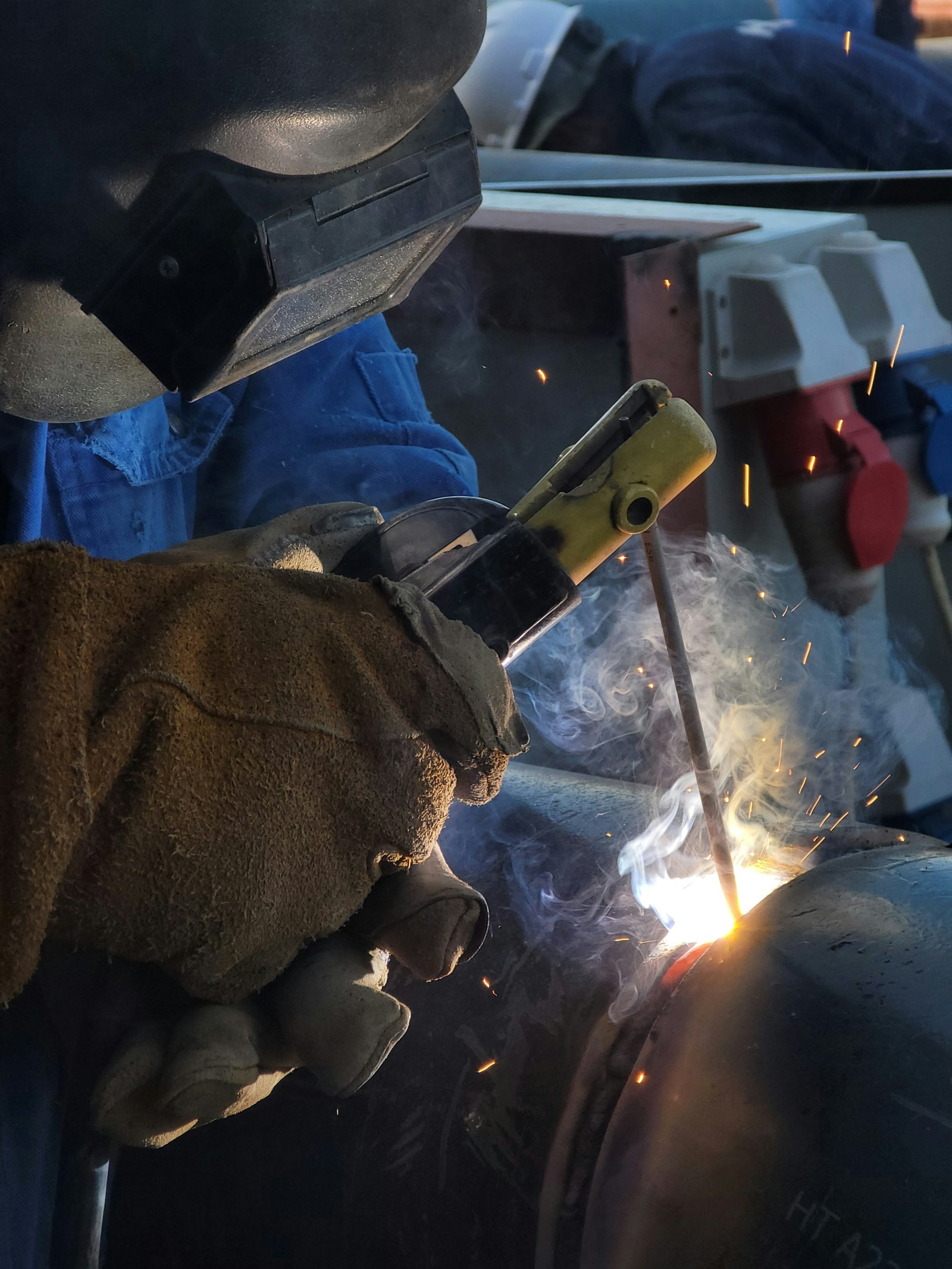
Side by side: ER308L vs. ER316L properties
AWS A5.9 classifies bare rods by chemistry, so strength figures come from manufacturer data sheets, not from the classification itself. The values below are typical as-welded numbers for TIG deposits. Your results depend on heat input, dilution, and joint design.
| Property | ER308L | ER316L |
|---|---|---|
| Typical tensile strength, as-welded | About 80 to 90 ksi (550 to 620 MPa) | About 80 to 90 ksi (550 to 620 MPa) |
| Typical yield strength (0.2% offset) | About 55 to 65 ksi (380 to 450 MPa) | About 55 to 65 ksi (380 to 450 MPa) |
| Typical elongation | About 35 to 45% | About 30 to 40% |
| Base metal it matches | 304, 304L | 316, 316L |
| Base metal minimum strength (ASTM A240, L grade) | 70 ksi tensile, 25 ksi yield | 70 ksi tensile, 25 ksi yield |
| Typical PREN (Cr + 3.3 Mo + 16 N) | About 20 to 22 | About 25 to 28 |
| Chloride pitting resistance | Moderate | Better |
| Delta ferrite in the deposit | Small amount, often about 3 to 10 FN | Small amount, often about 3 to 10 FN |
| Relative filler cost | Lower | Higher (molybdenum and extra nickel) |
Two points stand out. First, strength is not the reason to pick one over the other. Both deposits typically overmatch the 70 ksi minimum tensile of 304L and 316L plate. Second, the PREN gap is real. PREN (pitting resistance equivalent number) is a quick way to rank resistance to chloride pitting. A higher number means better resistance.
Why does molybdenum matter in chloride service?
Stainless steel stays stainless because chromium forms a thin, self-healing oxide film on the surface. Chloride ions attack that film at weak spots. Once a small pit starts, the chemistry inside the pit turns more acidic and the pit grows. Tight gaps, such as under gaskets or deposits, behave the same way. That is crevice corrosion.
Molybdenum makes the film harder to break and helps it re-form after damage. That is why 316L holds up better in salty, brackish, or chlorinated service. It is not immune, though. Some limits apply to both alloys
- Chloride stress corrosion cracking. Both 304L and 316L can crack under tensile stress in warm chloride service, often starting around 140 °F (60 °C). Extra molybdenum does not fix this.
- Full seawater immersion. For long-term immersion or hot brine, engineers often move to duplex 2205 (welded with ER2209) or a 6% molybdenum super-austenitic grade.
- Weld surface condition. Heat tint and sugared roots lower the corrosion resistance of either filler. Good purging matters as much as alloy choice. See our guide to preventing sugaring in stainless tube welding.
When is the ER316L premium justified?
Pay for ER316L in these cases
- The base metal is 316 or 316L. Match the filler. ER308L on 316L leaves a low-molybdenum stripe down the joint. The weld becomes the first place to pit.
- Coastal and marine service. Offshore skids, docks, ships, and Gulf Coast plants see salt spray every day.
- Salty or acidic foods. Brine, pickling lines, sauces, and tomato products are hard on 304.
- Chlorinated cleaning. Clean-in-place systems that use chlorinated sanitizers raise chloride exposure on every cycle.
- Pharma and biotech process lines. These are usually 316L by specification.
- Chemical plants. Process streams with chlorides or some dilute acids favor 316L.
ER308L is the right call in these cases
- 304 or 304L parts in indoor, dry, or climate-controlled service.
- Frames, enclosures, guards, and architectural work away from salt.
- Low-chloride water and most general food equipment built from 304.
- Jobs where the drawing calls for 304L and the service has been reviewed.
Can you mix grades in one joint?
Yes, with some rules. Here is how common joint pairs are usually handled
- 304L to 304L: ER308L.
- 316L to 316L: ER316L.
- 304L to 316L: ER308L is common, since the weld only needs to match the leaner side. Use ER316L if the 316L side was chosen for chloride resistance and the weld sees the same fluid.
- ER316L on 304L: Acceptable. It costs more, but it does no harm.
- Stainless to carbon steel: Neither one. Use ER309L, which has extra alloy to handle dilution from the carbon steel. See our guide to TIG welding 304 stainless to carbon steel.
How should you specify filler on a drawing?
- Name the filler by AWS A5.9 classification, for example “ER316L per AWS A5.9.”
- Name the base metal grade and spec, for example “316L per ASTM A240” for plate or the tube spec you use.
- State the shielding gas. 100% argon is typical for TIG on austenitic stainless.
- State back-purge needs and an oxygen limit for full-penetration joints.
- Add a ferrite range only if your service needs one, such as some high-temperature or non-magnetic parts.
- Call out post-weld cleaning and passivation, for example per ASTM A967.
- Ask for filler certs (CMTRs) by heat or lot so the chemistry is on file.
When do ER347 or ER309L make more sense?
ER308L and ER316L cover most stainless work, but two other fillers come up often enough that buyers should know when to expect them.
ER347 is stabilized with niobium (columbium). It is the usual filler for Type 347 and Type 321 base metal. Titanium does not carry well across the arc, so ER321 filler is rarely used and ER347 is the normal choice for 321. Stabilized fillers are chosen for service at elevated temperatures, where sensitization is a risk over long periods, and where the base metal itself is stabilized.
ER309L has more chromium and nickel than the base metals it joins. That extra alloy lets the weld absorb dilution from carbon steel and still stay a sound, corrosion-resistant stainless. It is the standard filler for joining stainless to carbon or low-alloy steel, for buttering layers on carbon steel and for cladding repairs. It is not a substitute for ER316L in chloride service, because standard ER309L has no added molybdenum.
For higher molybdenum needs, ER317L carries more molybdenum than ER316L and is used on 317L base metal or in more aggressive chloride service. Your drawing or the design engineer should name the filler. If it doesn’t, ask before welding starts.
Why does ferrite matter for hot cracking?
Austenitic stainless weld metal is designed to solidify with a small amount of delta ferrite. Ferrite dissolves more sulfur and phosphorus than austenite does, so those impurities do not collect in the last liquid between grains. A weld with too little ferrite is prone to solidification (hot) cracking, especially in restrained joints.
Standard ER308L and ER316L are balanced to deposit a low ferrite level. Ferrite can still shift with base metal dilution, heat input and nitrogen pickup from poor shielding. Ferrite is predicted from chemistry with the WRC-1992 diagram and measured on the finished weld with a magnetic ferrite gauge.
More ferrite is not always better. Cryogenic service needs limited ferrite to keep toughness at low temperature. Long service at high temperature can turn ferrite into brittle sigma phase. Parts that must be non-magnetic may need near-zero ferrite and special fillers. If your application has any of these needs, the ferrite range belongs on the drawing.
How does TIGTechs choose filler?
TIGTechs welds 304L and 316L stainless from our Dallas, TX shop. We match filler to base metal and service unless your drawing says otherwise.
Learn more about our precision stainless TIG welding, pipe and pressure vessel welding, and work for food and beverage processors and oil, gas, and petrochemical plants.
Not sure which filler your part needs? Send the drawing and the service conditions through our request a quote page, and we will recommend a filler with the price.
Frequently asked questions
It is not recommended. ER308L has almost no molybdenum, so the weld becomes the weakest spot for chloride pitting on a 316L part. Use ER316L unless the design engineer has reviewed the service and accepted lower corrosion resistance at the weld.
Yes. ER316L on 304 or 304L is acceptable and does no harm, because the weld carries more alloy than the base metal. The trade-off is cost, since ER316L filler is more expensive. Some shops stock only ER316L to keep things simple.
Not in any way that matters for most designs. Typical as-welded TIG deposits from both fillers fall around 80 to 90 ksi tensile and 55 to 65 ksi yield, well above the 70 ksi tensile minimum for 304L and 316L plate. Pick between them for corrosion resistance, not strength.
ER308L and ER316L are designed to leave a small amount of delta ferrite in the weld, often about 3 to 10 FN. Ferrite is magnetic, and it helps the weld resist hot cracking as it cools. If your part must be fully non-magnetic, specify a ferrite limit and talk to your welder before quoting.
For most work, yes. The L means carbon is held to 0.03% or less, which limits chromium carbide formation and the intergranular corrosion that can follow. Higher-carbon H grades exist for some high-temperature service, but they are a deliberate engineering choice.
Ferrite number is a standardized measure of the delta ferrite in austenitic stainless weld metal, read with a magnetic gauge calibrated to AWS A4.2. At low levels it roughly matches the percent of ferrite. Specifications use FN ranges to control hot cracking and service properties.
Yes, for the welding, not the chemistry. Rod diameter is matched to joint thickness and amperage. Thin sheet uses small rods such as 0.035 or 1/16 inch to add metal without extra heat, and heavier joints use 3/32 or 1/8 inch. Drawings normally specify the filler classification and leave diameter to the procedure.