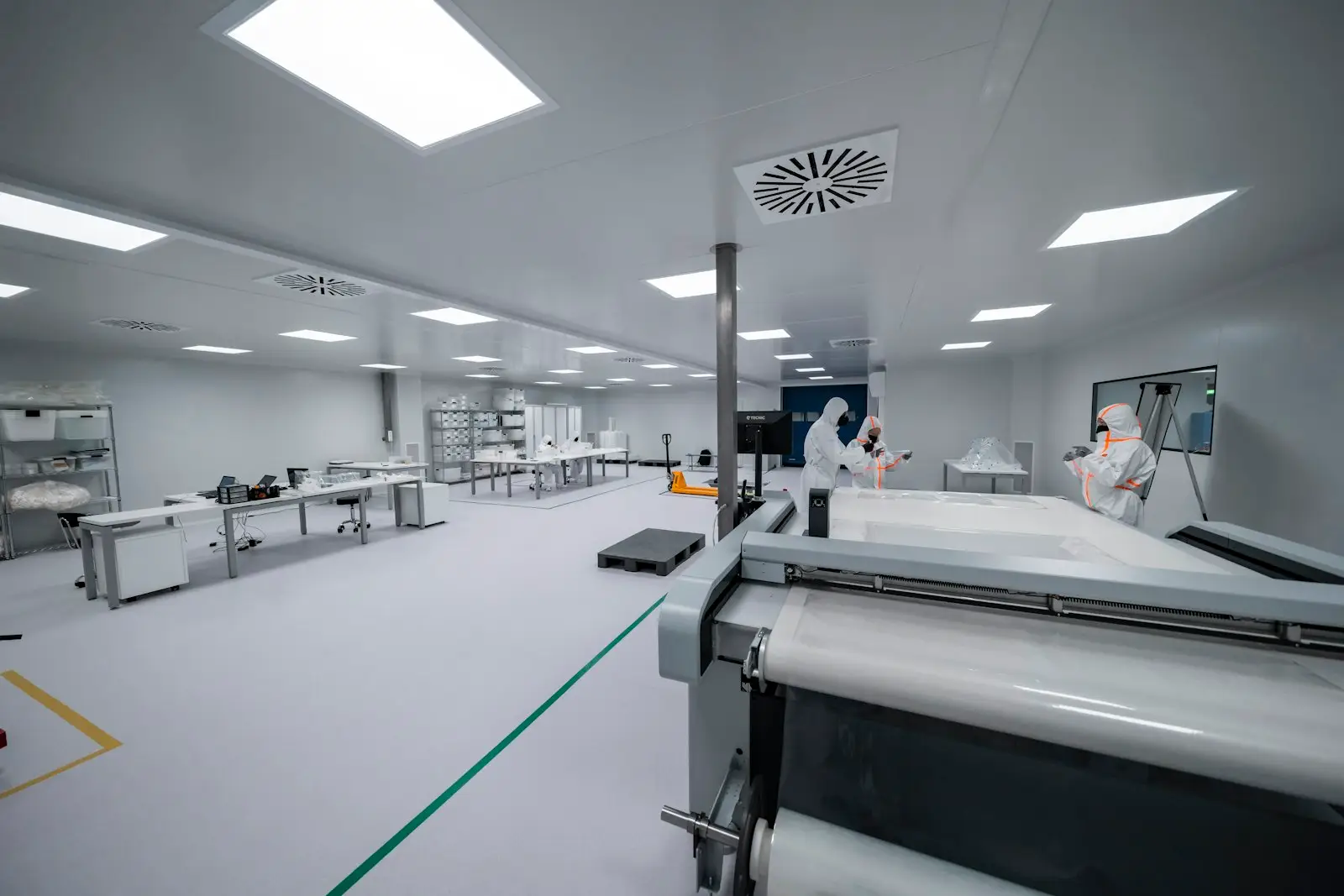
Semiconductor UHP gas lines are built from electropolished 316L stainless tube, joined with autogenous orbital TIG welds made under a high-purity argon purge, and cleaned, tested and bagged in a controlled clean area. Use orbital TIG for wetted production tube welds, and keep manual TIG for tight spots, odd joints and repairs that your fab spec allows.
That answer holds whether the line feeds a new fab in Phoenix or a tool hookup in the San Francisco Bay Area. The rest of this guide covers what “Class 100” means today, what a UHP line demands from each weld, and how manual and orbital TIG compare.
What does “Class 100” mean today?
“Class 100” comes from FED-STD-209E, the old U.S. cleanroom standard. It allowed no more than 100 particles 0.5 µm or larger in each cubic foot of air. The U.S. government canceled 209E in 2001, and ISO 14644-1 replaced it. Class 100 maps to ISO Class 5, which allows about 3,520 particles 0.5 µm or larger per cubic meter.
Two points matter for buyers. First, the welding is not always done in the cleanest room. Many UHP shops cut, face and weld in one area, then do final cleaning, leak testing and bagging in a cleaner zone. Second, room class is only one control. Tube prep, purge quality and packaging do more to keep particles and moisture out of your gas stream than the ceiling filters do.
Ask any vendor to show the room class on a current certification report, not just a brochure.
What does a UHP gas line require from each weld?
A UHP line carries process gases held to parts-per-billion purity. Every surface the gas touches must be smooth, clean and dry. The weld is the weak point in that chain, because it melts the electropolished surface and rebuilds it in a few seconds.
Tube and Fittings
- Alloy: 316L stainless, often double-melted (VIM/VAR) to cut inclusions.
- Sulfur control: Sulfur changes how the weld pool flows and how deep it goes. Specs often hold sulfur to a narrow band so one orbital program works from heat to heat.
- Inside finish: Electropolished ID, often 10 Ra µin max, with 5 Ra µin or better on the most sensitive lines.
- Common sizes: 1/4 in, 3/8 in and 1/2 in OD tube with thin walls, such as 0.035 in or 0.049 in.
Weld Quality Targets
- Full penetration with a smooth, even ID bead. Concavity and convexity stay inside spec limits.
- No filler metal on most tube welds. Autogenous welds keep the base metal chemistry and add nothing new to the wetted surface.
- Little or no heat tint (oxide color) on the ID. Many fab specs reject even light straw color.
- Bead width and bead wander inside the limits your fab sets.
Standards to Name in Your PO
Most fabs write their own weld spec. Many draw on SEMI F78 for the GTA welding practice, SEMI F81 for visual acceptance of weld beads, and SEMI F19 for wetted surface finish. U.S. gas systems are also often designed to ASME B31.3. Put the exact spec and revision on the purchase order. A vendor cannot hit a target that is not written down.
How is a UHP orbital weld made?
- Cut and face. Cut the tube with dry methods, then face the ends square with no burr. No cutting fluids touch the tube.
- Clean. Wipe the ends with lint-free cleanroom wipes and an approved solvent, using clean gloves.
- Fit up. Clamp the parts in the weld head with zero gap and matched walls. Any mismatch shows up as an uneven ID bead.
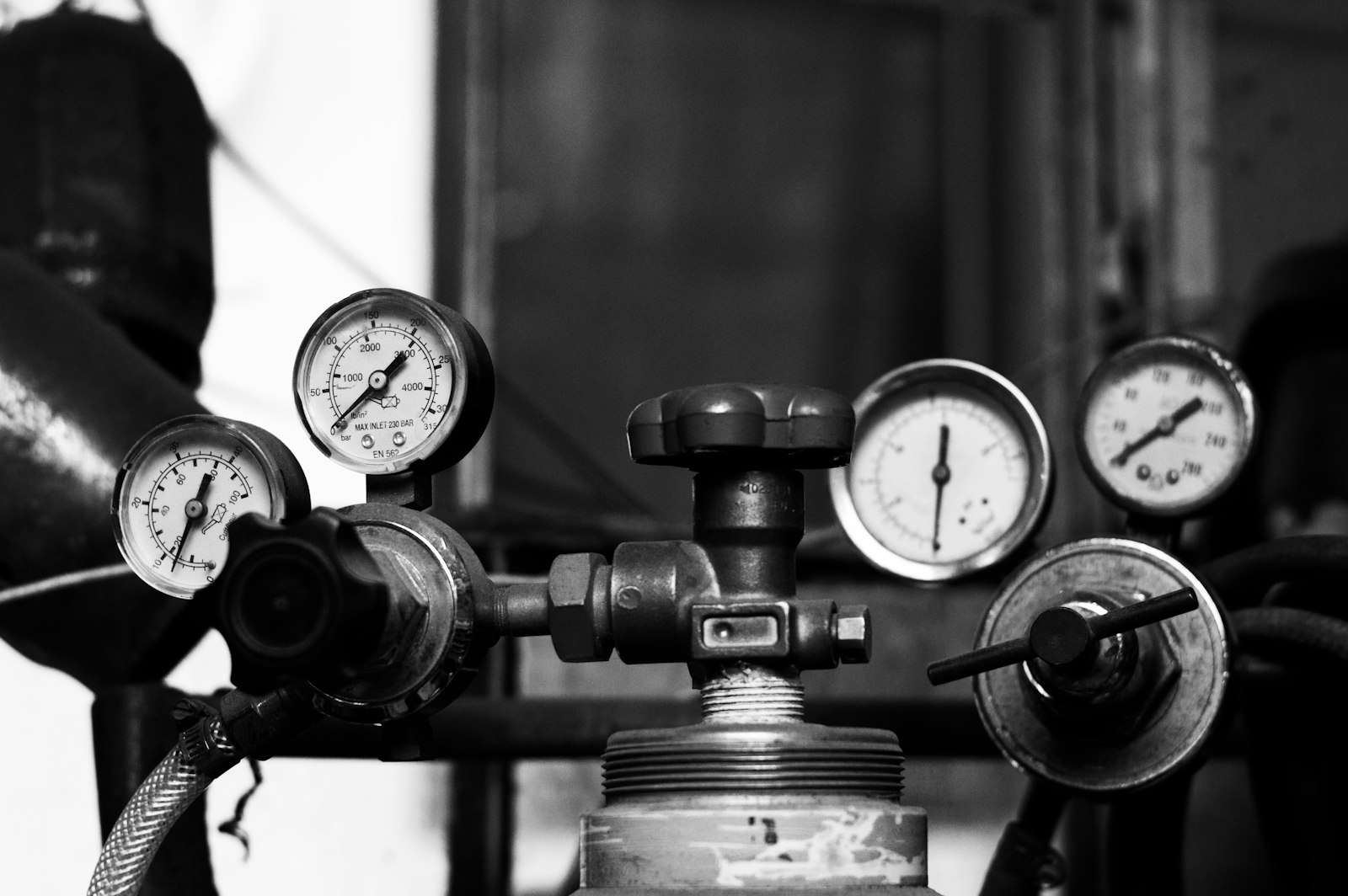
- Purge. Flow high-purity argon through the ID until an oxygen analyzer reads below the spec limit. Many shops check moisture too.
- Weld. Run the qualified orbital program. The power supply logs current, time and travel for each weld.
- Inspect. Check the OD bead by eye, and the ID with a borescope where it can reach.
- Test and bag. Helium leak test the assembly, then cap, purge and double-bag it for shipment.
Shops also weld sample coupons. A coupon is welded at the start of a shift and after a change of tungsten, weld head, power supply or tube heat. It is cut open, and the ID is checked before production welds go on. Coupons are the best proof you can get for welds you cannot see inside.
Common UHP weld defects include ID heat tint from a weak purge, uneven bead width from poor fit-up, and shallow penetration after a change in tube heat. Each one can shed particles, trap moisture or start corrosion in service. Many trace back to prep and purge, not to the weld program.
Purge is where many UHP problems start. If you want the physics of ID oxidation and purge setup, see our guide to preventing sugaring in stainless tube welding.
Manual TIG vs. Orbital TIG for UHP Lines
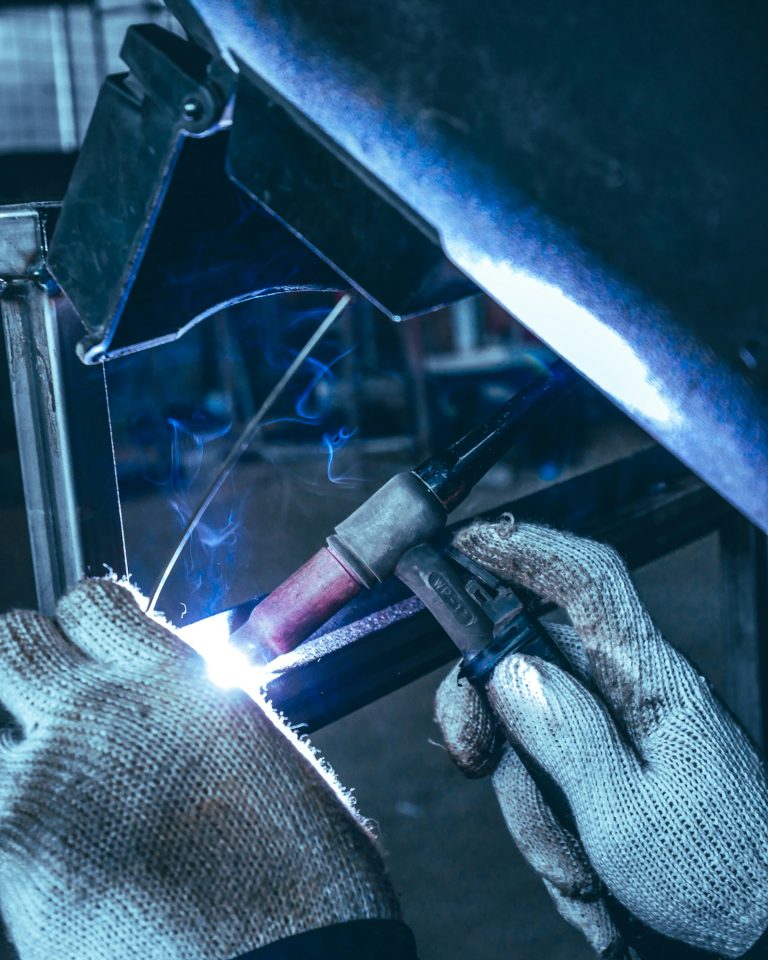
Orbital TIG uses a closed weld head that clamps the tube and turns the tungsten around the joint. A programmed power supply sets current, pulse and speed by position around the tube. Manual TIG depends on the welder’s hand, eye and torch control.
Orbital TIG: Pros
- Makes the same weld every time once the program is qualified.
- The enclosed head holds shielding gas close, which helps keep the OD bright.
- Stores or prints a data record for each weld, which supports traceability.
- Runs faster on long runs of the same tube size.
- Depends less on one welder’s skill on a given day.
Orbital TIG: Cons
- Needs a weld head sized for each tube OD and room to clamp it.
- Setup, coupons and program work add time on small jobs.
- Reacts strongly to poor fit-up, poor end prep and heat-to-heat sulfur shifts.
- Costs more in equipment, which shows up in the quote.
Manual TIG: Pros
- Reaches tight spots where a weld head will not fit.
- Handles odd joints, larger fittings and one-off repairs.
- Costs less to set up for a handful of welds.
Manual TIG: Cons
- Bead shape and penetration vary from weld to weld and welder to welder.
- Holding a smooth, even ID bead on thin-wall tube is hard to repeat.
- Leaves no automatic weld record unless the shop adds one.
- Many fab specs limit or ban it on wetted UHP welds.
| Factor | Orbital TIG | Manual TIG |
|---|---|---|
| Repeatability | High, set by the program | Depends on the welder |
| Weld data record | Built in | Manual log only |
| Access | Needs clearance for the head | Fits tight spots |
| Setup time | Higher | Lower |
| Best use | Wetted production tube welds | Repairs, odd joints, non-wetted welds |
Bottom line: Specify orbital TIG for wetted production welds. Allow manual TIG only where your spec permits it, and hold those welds to the same purge, inspection and leak test.
What should you ask a UHP welding vendor?
- What cleanroom class do you weld in, and what class do you bag in?
- Which fab weld specs and revisions have you built to?
- How often do you weld and cut open test coupons?
- What oxygen and moisture levels do you purge to, and how do you measure them?
- Do you keep a data record for every orbital weld?
- What helium leak rate do you test to?
We serve fabs in Phoenix and the San Francisco Bay Area. Learn more on our semiconductor and cleanroom welding page. For thin-wall tube work in other clean industries, see sanitary tube welding and precision stainless TIG welding.
Have a UHP line or weldment to price? Send your drawings and fab spec through our request a quote page.
How is a UHP line tested and turned over?
A finished ultra-high-purity gas line is not accepted on the strength of its welds alone. Before it connects to a tool, the line goes through a set of tests that prove it is tight, clean and dry.
- Helium leak test: a mass spectrometer leak detector checks every weld and fitting. Fab specifications commonly call for leak rates in the range of 1×10⁻⁹ atm·cc/s.
- Pressure test: the line is held at a set pressure to confirm there are no gross leaks or weak joints.
- Particle test: purge gas is run through a particle counter to show that the line is not shedding particles.
- Moisture and oxygen tests: analyzers confirm that moisture and oxygen in the purge gas are down to the parts-per-billion levels the spec requires.
Weld quality is also proven with sample coupons. Coupons are made at the start of each shift, after any change to the weld head or settings, and at intervals the spec sets. Each coupon is cut open to check penetration, bead width and inside-diameter color. SEMI F78 and SEMI F81 are the usual references for orbital welding practice and visual acceptance, but the fab’s own specification always governs.
Turnover ends with a documentation package: test reports, coupon results, the weld log and the as-built drawing. Without it, the line does not get released for gas.
What does a UHP weld log record?
The weld log makes every joint traceable. If a leak or contamination problem appears later, the log shows exactly how that weld was made. A typical entry records
- The weld number, matching the isometric drawing
- Date, time and the operator who made the weld
- Weld head and power supply serial numbers
- The weld schedule (program) used
- Tube and fitting heat numbers
- Purge gas source and the oxygen reading before the arc
- The related coupon number and its result
- Inspection results and sign-off
Ask for a sample weld log when you qualify a UHP vendor. An incomplete log is one of the clearest signs that a shop is not set up for semiconductor work.
Frequently asked questions
They are close equivalents. FED-STD-209E Class 100 allowed 100 particles 0.5 µm or larger per cubic foot, and ISO Class 5 allows about 3,520 per cubic meter, which works out to about the same. Since 209E was canceled in 2001, new specs should cite ISO 14644-1.
Thin-wall tube with square, faced ends fuses fully without filler. Leaving filler out keeps the base metal chemistry the same and adds nothing new to the wetted surface. Some larger fittings or special joints may differ, so check your fab spec.
Common causes are a change in sulfur content between heats of tube, poor end facing, wall mismatch, a worn tungsten and changes in purge pressure. That is why shops weld and cut a test coupon after changing tube heat, tungsten or weld head.
Inspectors check the OD bead by eye, view the ID with a borescope where it can reach, and helium leak test the assembly. The orbital weld data record shows the program ran as qualified. Cut-open coupons made with the same setup back up the welds you cannot see.
TIGTechs serves semiconductor customers in Phoenix and the San Francisco Bay Area. Send your fab weld spec and drawings with your request so we can confirm fit before quoting.
A VMB (valve manifold box) is an enclosure that splits one gas supply line into several branches feeding different tools. It holds isolation valves, purge connections and, for hazardous gases, exhausted containment. VMB tie-ins are a common place for orbital welds.
A gas stick is the line of components on a tool’s gas panel that delivers one gas to the process chamber: valves, a regulator, a filter, a mass flow controller and pressure transducers. Many modern sticks use surface-mount components on modular substrates instead of welded tube between each part.